
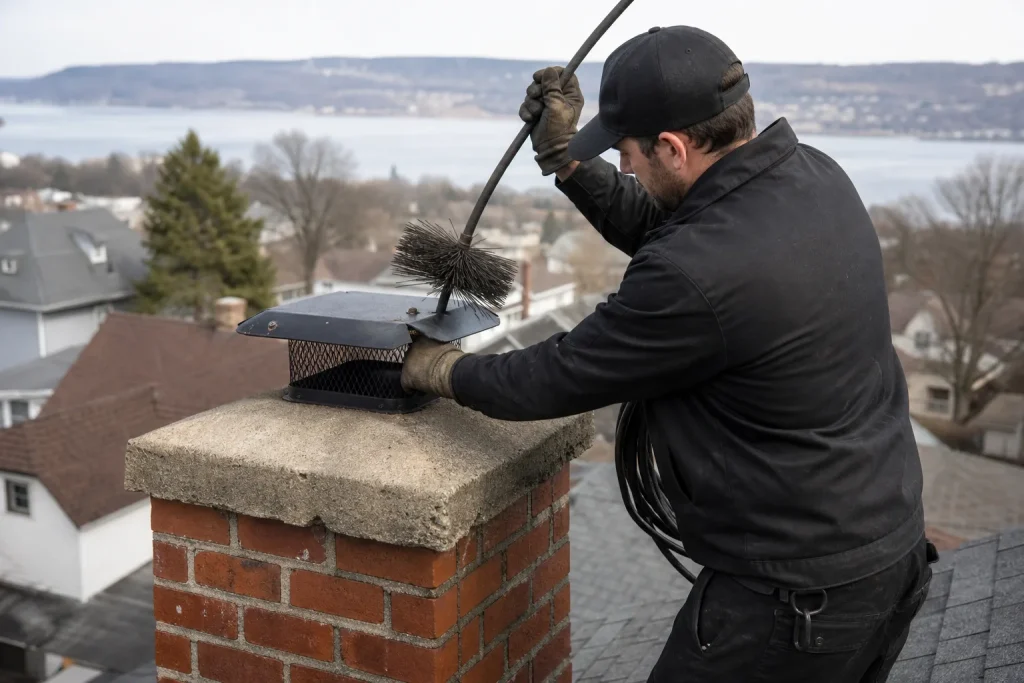
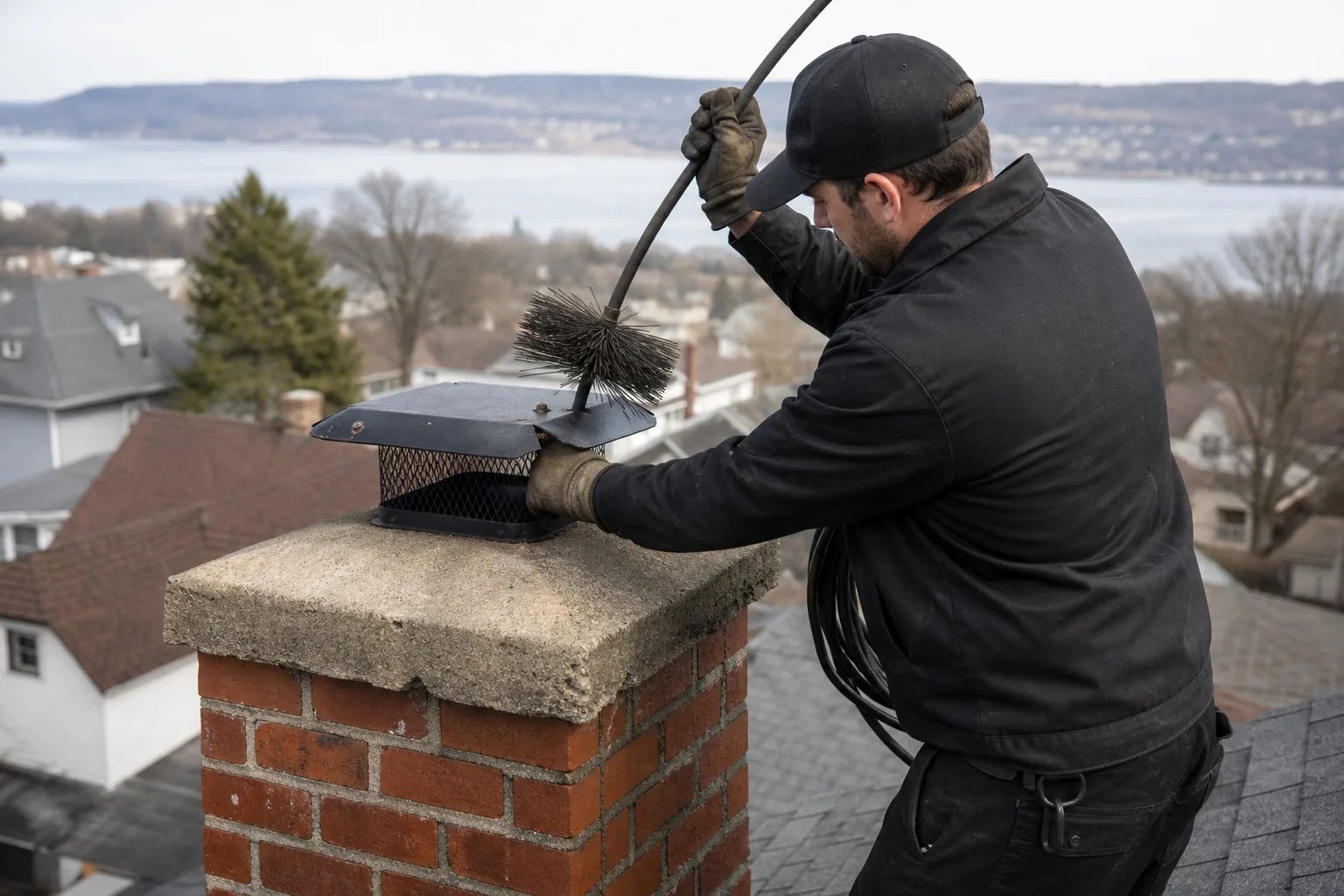
DuraFlex Chimney Cleaning & Sweep in Yonkers: A Homeowner’s Guide
DuraFlex chimney liner systems in Yonkers homes typically require specialized cleaning every 1–2 years for gas appliances, but if the liner has been exposed to wood smoke or wasn’t properly sized during an oil-to-gas conversion, the maintenance protocol changes completely. Standard chimney brushes can damage the corrugated interior, and connection points at bends need inspection that rigid liners don’t. If you’d rather not figure out which category your system falls into, give us a call at (844) 660-6590 — we’ll tell you what you’re actually dealing with before we quote anything.
Here’s the thing we’ve learned after 11 years on roofs across Yonkers: DuraFlex liners are everywhere now, and half the problems we find trace back to how they were installed during the oil-to-gas conversion boom, not the product itself. We pulled one out of a home in Getty Square last month where the previous owner had been running a wood insert through a liner rated for gas-only — the corrugated walls had packed with creosote in ways a standard brush would have just compressed further. That’s not a cleaning problem; that’s a “someone didn’t read the spec sheet” problem, and unfortunately, the next owner inherits it.
What Makes DuraFlex Different From Rigid Liner Systems
DuraFlex is a corrugated stainless steel flexible liner manufactured by Olympia Chimney, designed specifically for venting gas appliances — boilers, furnaces, and water heaters. The corrugations give it flexibility to navigate offsets and bends in older chimney flues, which is why it became the go-to choice for Yonkers’ wave of oil-to-gas conversions over the past two decades.
But that same corrugation creates cleaning challenges rigid liners don’t have:
- Brush selection matters enormously. Standard wire or stiff poly brushes can catch on the corrugated ridges and actually deform the liner. We use softer, appropriately sized brushes — typically one size down from the liner diameter — and avoid anything with aggressive bristle angles.
- The surface area is higher than it looks. Those corrugations create tiny pockets where debris collects. A straight pull-through doesn’t clean effectively; we work in short, controlled strokes with rotation.
- Bends are stress concentrators. Every offset in a DuraFlex run is a point where the liner flexes, and over years of thermal cycling, these spots thin faster than straight runs. We inspect these with a camera every time, not just visually from the top.
In Yonkers’ stock of pre-war and mid-century housing, chimney flues rarely run straight. DuraFlex solved the installation problem, but it introduced a maintenance protocol that a lot of generalist sweepers still don’t follow correctly.
How to Tell If Your DuraFlex Liner Was Sized Correctly
This is where we see the most hidden problems in Yonkers homes. During the rush of oil-to-gas conversions in the 2010s, some installers sized liners based on what fit the flue, not what the appliance required. An undersized DuraFlex liner creates excessive draft, which sounds like it would help — but it actually pulls combustion gases through too fast, causing condensation, corrosion, and in worst cases, carbon monoxide spillage.
Here’s what we check on every DuraFlex inspection in Yonkers:
- Appliance BTU rating versus liner diameter. A 4-inch DuraFlex might handle a 100,000 BTU boiler, but push it to 150,000 and you’re out of spec. We cross-reference the appliance plate against Olympia Chimney’s sizing tables.
- Total liner length and rise. Horizontal runs or excessive vertical height changes the draft calculation. We’ve found liners in Ludlow Park homes that were technically the right diameter but functionally undersized because of a 25-foot vertical run with minimal rise.
- Connection method at the appliance. DuraFlex should terminate with a proper appliance adapter, not a cobbled sheet-metal transition. Loose connections leak — and in a basement mechanical room, that’s not something you want to discover by smell.
If your DuraFlex was installed before you owned the home and you don’t have documentation, we can usually determine sizing adequacy in about 20 minutes of inspection. It’s worth knowing, especially if you’ve noticed condensation stains on the chimney exterior or rusting at the cleanout.
The Real Service Life of DuraFlex in Yonkers Conditions
Manufacturers rate DuraFlex liners at 15–20 years under ideal conditions. In Yonkers, “ideal” is rare. We’ve replaced DuraFlex that’s failed in 8 years and seen other installations going strong at 18. The difference is almost always environmental, not material.
Conditions that accelerate DuraFlex degradation in Yonkers homes:
- Exterior chimney exposure. Chimneys on north-facing walls or with deteriorated masonry absorb more freeze-thaw moisture. That moisture migrates to the liner, and even 316Ti stainless steel has its limits.
- Improper appliance tuning. A gas boiler running rich produces more moisture and acidic condensate. We see this often in older Yonkers homes where the appliance hasn’t been serviced annually.
- Mixed-fuel use. This is the big one. DuraFlex is gas-rated, not wood-rated. Wood smoke carries creosote and higher temperatures that the corrugations trap and the material isn’t designed to handle. We’ve found three instances in the past two years where a new homeowner assumed their liner was “standard” and started using a wood insert — the liner was compromised within a single season.
Our practical rule: if your DuraFlex is over 12 years old and serves a high-efficiency condensing appliance, plan for a camera inspection every year, not every other. The cost of early replacement beats the cost of a liner failure in January.
Inspection Checkpoints Specific to DuraFlex Systems
Every DuraFlex sweep we perform in Yonkers includes inspection points that wouldn’t apply to a rigid stainless or clay flue:
- Top termination cap condition. DuraFlex uses a specific termination cap with proper clearances and rain protection. We’ve found caps installed upside-down, missing entirely, or substituted with generic hardware-store versions that don’t seal correctly. Water entry at the top is the fastest path to liner failure.
- Connection integrity at offsets. The flexible sections are joined with specialized collars at bends. These can loosen from thermal expansion cycles — we check torque and condition every visit.
- Liner wall thickness at corrugation valleys. Camera inspection lets us measure remaining material. When valleys thin below manufacturer minimums, replacement timing becomes a conversation, not an emergency.
- Condensate drainage. High-efficiency appliances produce water that needs to drain, not pool. We verify the condensate management path is clear and properly sloped.
These aren’t “nice to have” checks — they’re the difference between catching a problem in October and discovering it when the boiler won’t light on a 20-degree night in Yonkers.
When DuraFlex Needs Replacement Versus Repair
This is where homeowners get conflicting advice, and frankly, where the cost difference makes second opinions worthwhile. A full DuraFlex replacement in a Yonkers home typically runs several times the cost of a repair or localized fix — so the “replace it” recommendation should meet a high bar.
In our experience, DuraFlex is repairable when:
- Damage is localized to a short section (typically the top 3–4 feet)
- Connection collars can be reseated or replaced
- The liner body is intact and thickness readings are acceptable
- The underlying problem was external (bad cap, water entry) and correctable
Replacement makes sense when:
- Wall thinning is generalized, not spotty
- Multiple offset sections show fatigue cracking
- The liner was incorrectly sized from installation — no repair fixes wrong sizing
- Mixed-fuel use has compromised the material throughout
We’ve had Yonkers homeowners tell us another company quoted full replacement when the issue was a $200 termination cap and some localized resealing. We’ve also seen the opposite — a “quick fix” on a liner that was clearly end-of-life. Gary leads every job himself, and we’ll show you the camera footage so you can see what we’re seeing. That’s not courtesy; it’s how you make an informed decision on a multi-thousand-dollar call.
Related Services in Yonkers
If your inspection reveals issues beyond the liner itself, we handle the full scope without handing you off. From Sterling Chimney Cleaning Yonkers home, we also provide Chimney Cleaning & Sweep in Bronxville, Chimney Repair in Bronxville, and Fireplace Services in Bronxville — though our Yonkers customers get the same direct service without the geographic handoff.
What happens when you call
- 1
A real person answersNo phone trees — you reach a local pro.
- 2
You get an upfront price rangeHonest numbers before anyone is dispatched.
- 3
A background-checked tech heads outLicensed & insured, dispatched right away.
- 4
You approve before work beginsNothing starts until you say go.
The Bottom Line
DuraFlex liners are a solid solution for gas-venting in Yonkers’ older housing stock, but they’re not maintenance-free and they’re not forgiving of misuse. The corrugated construction demands specific cleaning tools and techniques, sizing must match the appliance precisely, and the real-world lifespan depends heavily on installation quality and environmental conditions. If your home had an oil-to-gas conversion and you don’t know what liner is in your chimney, that’s worth finding out before you need to rely on it.
Key takeaways:
- DuraFlex is gas-rated, not wood-rated — mixed use damages the liner and creates safety hazards
- Standard chimney brushes can deform corrugated walls; proper tool selection is essential
- Undersized liners from rushed conversions are common in Yonkers and affect performance
- Camera inspection at bends, connections, and the termination cap catches problems early
- Replacement versus repair is a significant cost decision — get visible evidence, not just a verbal recommendation
If you’re in Yonkers and want to know what you’re actually dealing with, Sterling Chimney Cleaning Yonkers offers free estimates with no pressure to book. Gary Murphy will inspect the system personally, show you the camera footage, and give you straight numbers on whether you’re looking at maintenance, repair, or replacement. Call (844) 660-6590 and we’ll get you scheduled.
Frequently Asked Questions
DuraFlex chimney cleaning in Yonkers typically ranges from $180–$280 for a standard gas-appliance sweep with camera inspection, assuming the liner is in serviceable condition and accessible. If the liner has been exposed to wood smoke or requires creosote removal, the process takes longer and runs higher — usually $280–$400. We price after seeing the setup, not before. Call (844) 660-6590 for a free estimate — we’ll tell you exactly what you’re looking at.
You can attempt it, but we don’t recommend it. The corrugated interior requires specific brush types and diameters — wrong tools deform the liner or pack debris into the ridges. More importantly, without a chimney camera, you can’t inspect connection points, wall thickness, or offset integrity. We’ve been called to fix DIY cleanings that missed a separated collar at a bend, which was leaking combustion gases into the home. For safety-critical work, a trained eye matters.
Check three things: documentation showing the liner diameter matches your appliance BTU rating, a gas-rated termination cap (not generic), and no evidence of wood-burning use if the liner is DuraFlex. If you lack documentation, a camera inspection can verify sizing, connection quality, and condition. In Yonkers, we’ve found that roughly one in four DuraFlex installations from the conversion era has a sizing or connection issue. It’s worth confirming.
Localized damage — typically at the top section or a connection collar — usually costs $400–$900 to repair. Full replacement runs $2,500–$5,000+ depending on length, access, and whether the chimney needs masonry work. The critical factor is whether the liner body itself is sound. We provide camera evidence and a clear recommendation either way. If another company quoted replacement without showing you why, a second opinion is worth the call.
Written by Gary Murphy, Owner & Lead Technician at Sterling Chimney Cleaning Yonkers, serving Yonkers since 2015.
Need Chimney Cleaning Help?
Call Sterling Chimney Cleaning Yonkers — licensed & insured, here with fast after-hours help in Yonkers.
(844) 660-6590